
Ten Pheasants, Twelve Grouse, Thirty-Two Partridges, Twelve Turkeys, and Four Guinea Fowl
The Grand Gastronomic Opening of Filey Railway Station

It is quite remarkable to think that, since the introduction of the hourly service between Scarborough and Hull in 2019, Filey station now enjoys the best train service in its 180-year history. Yet, aside from a modest press release, the new trains went about their work with very little fanfare. As you might imagine, it was a completely different story when the railway first arrived. Our Victorian ancestors fully understood the revolutionary impact of a rail connection—and they celebrated it in magnificent style.
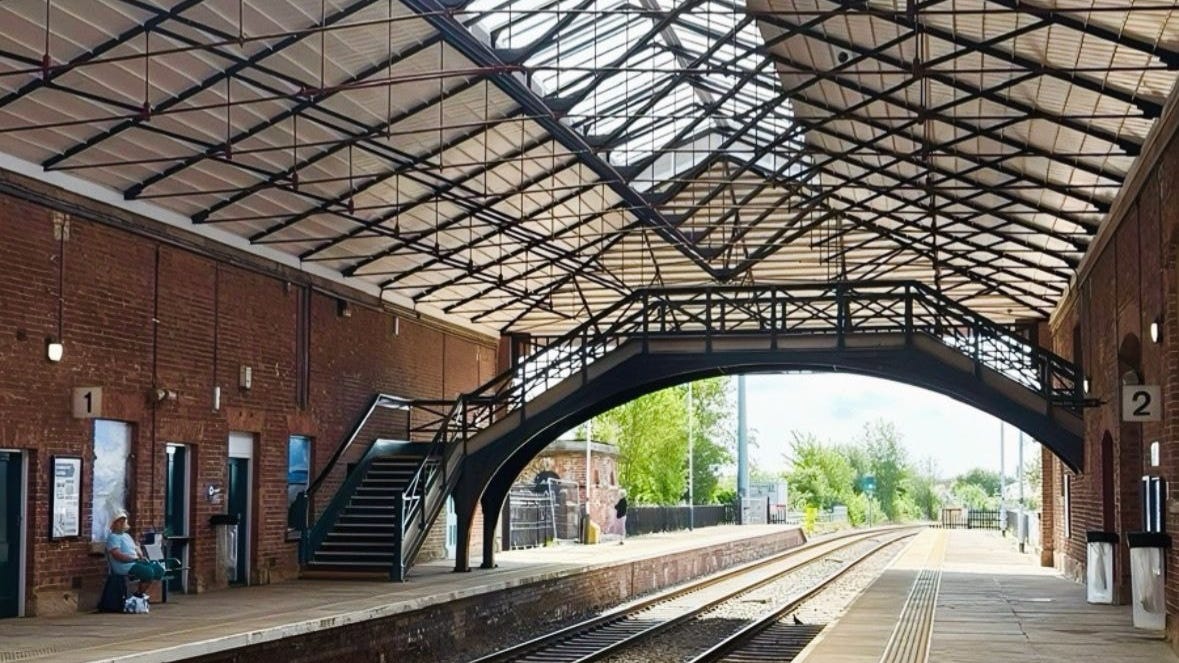
The restored lantern roof at Filey (Network Rail)
Let us travel back to 1846. Queen Victoria was on the throne, and that same year, she received the legendary Koh-i-Noor diamond following Britain’s annexation of the Punjab. Charles Dickens was publishing Dombey and Son, the world’s first public park opened in Manchester, and the planet Neptune was discovered. Most importantly for our story, ‘Railway Mania’ gripped the nation, with Parliament passing 272 Acts to permit the construction of thousands of miles of track.
Permission to bring Filey into this rapidly expanding network had been granted the previous year under ‘The York & North Midland Railway (Bridlington branch) Act 1845’. Designed to connect the newly opened York–Scarborough line with the route from Hull to Bridlington, it formed the route we know today. The initial stretch between Seamer and Filey was relatively straightforward to build, requiring no bridges, few earthworks, and only eight level crossings. Alongside Filey, modest stations were also provided at Cayton and Gristhorpe.
Opening day was set for Monday 5 October 1846. A five-carriage train steamed out of York carrying the region’s elite: George Hudson, the chairman of the York and North Midland Railway; William Richardson, the Lord Mayor of York; Sir John Lowther MP; and Sir Frederick Trench, the MP for Scarborough.
In Filey, a grand procession gathered at the Foords Hotel before marching to the station to greet the train. Leading the way was a brass band provided by Henry Bentley of Ravine Villa, while fully uniformed members of the Filey coastguard—brandishing gleaming cutlasses—acted as bodyguards to the dignitaries. Local school children carried three silk banners aloft. One proclaimed, ‘Success to Hudson and the Directors’, emblazoned on the reverse with ‘Filey branch, opened October 5th 1846’. The second stated simply, ‘Trade and Commerce’, while the third wished ‘Prosperity to the town and trade of Filey’.
As the train glided into the station just before 1.30pm, the band struck up ‘See the Conquering Hero Comes’. George Hudson, the self-styled ‘Railway King’, marched proudly at the head of the disembarked passengers. The ladies followed in three elegant carriages, the first a splendid sight drawn by four grey horses. Packed crowds watched the procession wind its way to Ravine Villa, the residence of brewer Henry Bentley.
The villa stood in what is today Glen Gardens. There, a lavish dinner party was held for 120 guests. They split into three rooms: the dining room, the breakfast room, and the largest party out on the lawn, enjoying sweeping views of the sea. Together, the guests feasted on ten pheasants, twelve grouse, thirty-two partridges, twelve turkeys, four guinea fowl, four hams, and five tongues—all followed by pastries, jellies, and fresh fruit. The lawn party also tucked into a staggering roast leg of beef weighing 145 pounds!
After promenading through the grounds, the dignitaries caught the 5pm train back to York. But the party wasn’t over. A second dinner was held at the ‘New Hotel’, capped off by a spectacular fireworks display orchestrated by pyrotechnist Mr L.V. Gyngell.
Extending the line from Filey to Bridlington proved a far greater engineering challenge as it cut through the Yorkshire Wolds. Unlike the flat Seamer stretch, this section required eighteen brick bridges, two large girder bridges, and heavy earthworks near Hunmanby. When it finally opened on 20 October 1847, the through-route between Scarborough and Hull was complete.
For the next 180 years, the line faithfully served the Yorkshire coast. Although the stations at Cayton, Gristhorpe, and Speeton have long since vanished, and private cars became the norm, the railway’s only existential threat came in 1968. When British Railways applied to close the entire line, local opposition was fierce: 3,444 written objections were submitted—a record number for a closure proposal at the time. Saved on 5 August 1969, Filey avoided the grim fate of so many British towns that lost their rail links.
Last year the station benefited from a £3.6m refurbishment. The project included repairs to the lantern roof—including extensive glazing and tile work. There were also improvements to the café, toilets, drainage, and in the train shed. Along with the installation of the replica North Eastern Railway tiled map, funded by the Yorkshire Coast Community Rail Partnership, the town now has a station it can be genuinely proud of and one that is a fitting gateway to the little gem of the Yorkshire coast.
Frozen Lines: The North Eastern Railway Captured in Ceramic

In my recent book On the Tracks of the Flying Scotsman, the route of the famous express is followed across a railway landscape shaped by Victorian ambition and Edwardian confidence, a world in which the railway was seen as permanent, progressive, and almost indestructible. One of the most striking surviving symbols of that mindset is not a locomotive, b…